I have bought seeds from moreveg.co.uk – back in September 2014 I bought one of their September Sowing packs. This included Raab Quarantina which I hadn’t seen anywhere else. Lovely fast delivery – they arrived the next day. Small packets of seeds, with instructions inside zip lock bags so you can reseal them easily and not lose any. Nice way of doing things when you don’t want hundreds of seeds left over.
I have also got seeds from vegetableseeds.net in their sale. Went a bit mad and spent over £10! Seeds from 19p though so I got an enormous package when they arrived. Delivery was a bit slow but as it was that time of year when you can’t sow anything then it didn’t really matter. I ordered at the beginning of the sale and delivery took a week. It seems that a friend who ordered a day or so after me had to wait much longer for delivery.
And if you’d like to see my stash of seeds then here’s a quick video
I’ve made a list of all the seeds I have. It’s a big list! I wouldn’t be able to grow all of these seeds even if I had an acre of land! I need to par down the list and decide exactly what I’ll be growing.
I’ve got tons of tomato seeds, including a favourite sun gold and some new ones that are also cherry tomatoes that should produce good crops. As I have a greenhouse at home as well as on the allotment I could grow lots of different sorts. I’ve tried a lot of outdoor tomatoes last year and was disappointed, only the sun gold ripened and didn’t get blighted.
I think I’ll grow sun gold outdoors as usual and then grow a few indoor ones in both greenhouses. I’ve got some baby plum tomatoes in different colours – think that one is called Rainbow mix. They’re excellent!
I will be growing directly into the greenhouse border on the allotment. I will be bagging up some of the heap of horse muck that I have got, ready for topping up the borders later in the spring. Currently I have some winter lettuces in the greenhouse and they’re delicious! Even though we’ve had some hard frosts there are still plenty of leaves available. I will be growing some of them again!
I want to sow a few carrots in the greenhouse border. Nantes should give me a small crop in only two months, so I will have a look through my carrot seed list and see whether I have some, or if I have some other carrots that might grow in a cold greenhouse border in early spring. I have some very tiny round ones, suspect they’ll be really good.
I am going to do my best to get brussels sprouts for this next year too. Mine got eaten by slugs as I was hardening them off, so I need to take more care whilst doing that in future. I’m going to try and have as long a season as possible, which will mean a mix of plants. I have one called brussels sprouts f1 Continuity mix which I hope will be really good. I will also plant some kale and some purple sprouting. Having green vegetables over winter means you can pick something everyday.
I’ve been reading Charles Dowding’s books about growing winter vegetables and feel quite inspired. He counts a lot of early spring vegetables as winter veggies which is an interesting idea. It’s mostly got to be ocncentrating on sowing in August and September for over winter salads, but much earlier in the year for sprouts and that sort of winter vegetables. I will of course grow a few extra plants for spares. They can either be insurance against slug damage or be given away to other plot holders when it’s time to plant out. It takes only one seed and a bit of compost to create a plug plant that can be planted on. That’s something elde Charles goes on about is planting in module trays so you can grow lots of plants easily and you’re growing them with their own root block. For salads it’s easy – sow and plant out into rows. He also recommends wider spacings for preference as the extra bare soil means it’s further for the slugs to go. As well as keeping the beds very tidy to ensure there’s no hiding places. That’s something I’d noticed with the wooden bed edges, that the slugs love living down the sides in the grass. I will aim to deal with this as a long term problem – I think wood makes an ideal home for slugs so might move away from this as edging and have bare sides. It won’t look as tidy but in theory it’ll mean fewer slug hiding places.
My other thoughts on the upcoming year will be to find a way of having all my plant pots so they don’t act as a slug house either. I am not sure what to do with them all. I probably don’t need all the hundreds of them I’ve got, but I’ve got some nice size pots that I am reluctant to get rid of. I am sure I can find a use for them even if it’s potting up plants for people.
I will hopefully get organised enough now I’ve got plenty of plant labels. Each packet has a pencil in to use to write on them with. This should mean I have no excuse for anything not having a label.
I want to remove the gooseberry from my fruit patch on the allotment. I’ve also got one in the front garden. We don’t eat the fruit from it – although I have used it in mixed fruit jam, where it was nice, I don’t really have enough space for something we don’t enjoy eating on it’s own, so they have to go.
I have a goji berry that hasn’t fruited yet, and my blackberry plants need sorting out as they are a bit wild. I need to read up on training and pruning them.
I’m hopeful of a good rhubarb crop as I have three well established plants now and a couple of additional ones that I can crop from this year. I grew some from seed and gave away quite a few plants but kept some for my plot. I did mean to do some rhubarb wine this year but didn’t get round to it. It is supposed to be a mild wine that can be used as a mixer with other wines to give balance.
I’ve given away a couple of crowns in the last few weeks. I gave one to Janet who has a plot on another site and one to a children’s home where they are hoping to grow loads of vegetables and fruit. I also gave away raspberries and a blackcurrant bush.
If you have blackcurrants then you can make new plants very easily. Take cuttings and put them in a bucket of water and ignore for a few months. Then pot them up or plant them out and they’ll grow like mad. It’s an easy way of getting more fruit bushes. It is very simple to do. In theory it works for redcurrants and white currants too.
So on my plot I need to finish moving muck, fill all the plastic sacks I have available and then any remaining muck I will let Tracey and John have. I’m a firm believer in the value of adding manure to the plot to raise the soil level up as well as feeding the worms and soil. The organic material is useful on a clay rich plot and by building the soil level up I hope to have a drier plot to plant in. Bits that are low are very soggy when it’s wet. My paths are made from bark chippings which help soak up moisture too. When they rot down they can be thrown onto the beds as soil too and replaced with more bark chippings.
You can make soil by layering bark chippings and manure and letting it break down. This can help very much if you have a shallow top soil. Don’t worry about the bark robbing nitrogen from the soil – there is plenty in the muck! You can grow potatoes as a first crop in this and feed them a bit too and you’ll get an amazing crop and next year the soil will look like proper soil!
Some people think it’s ok to just use chemicals to feed plants. I do think that adding manure adds to the soil itself – so you’re not just feeding the plants, but feeding the entire microcosm of the soil and all the organisms that live within in.
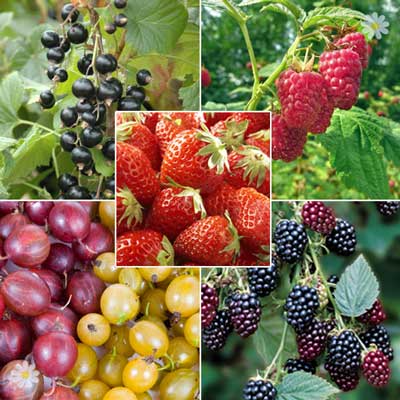
The Complete Fruit Bush Garden £19.99
If youve ever wanted to grow your own fruit, this set is perfect! Weve picked some of the best varieties to give you a complete fruit garden, and bumper crops from this year onwards! Growing fruit is incredibly rewarding & surprisingly easy, and of course your home-grown fruit will taste simply delicious! Perfect for eating fresh, the sweet, juicy berries will also make incredible summer puddings, desserts, or jams! Now is the perfect time to plant and they are very easy to grow. All of these varieties will produce large crops on compact bushes, perfect for patio pots and containers you dont even need a garden!
Included in this collection: 10 x Darselect strawberry runners 5 x Glen Ample raspberry canes 2 x Ben Lomond blackcurrant plants 2 x Hinnomaki gooseberry bushes (1 x red; 1 x yellow) 2 x Waldo blackberry plants
Tomato Plants – Crimson Crush £7.99
As well as its ability to shrug off even the worst blight, Crimson Crush will provide great yields of exceptionally fine tasting, large, round tomatoes (each weighing up to 200g). Bred for outdoor growing, it’s the tomato that everyone should be planting this year.
‘Crimson Crush’ is a standard indeterminate tomato.
Can be grown either outside in the ground or a container.
Bright red fruits.
Weigh 7oz/200g
Large trusses
it has the PH2 and PH3 genes which make it resistant to all common British blight strains
The Big Allotment Challenge is back, and this time nine gardeners go head to head in the competition hosted by Fern Britton. Over six episodes, the allotmenteers are put to the test in a series of challenges in the same three categories as last year: Grow, Make, Eat, judged by Jim Buttress, Jonathan Moseley and Thane Prince respectively. First episode goes out on Friday 2nd January 2015 at 9.00pm BBC2. – much earlier this year
Maybe they’ve realised us gardener’s are actually inside a bit more in the winter?
A list of UK potato days!
brilliant list of potato days around the UK.
They’re starting to add in this years *The ones in green! Not many yet but there should be loads again!
Make sure you get along to one! They’re a brilliant place to go and buy your seed potatoes.
If you find out there’s one near you not listed then contact them!
Apart from sowing a few onion seeds indoors this month, there’s not a huge amount to do other than tidy up and harvest crops.
I’ve got plenty of lettuce growing in my greenhouse still. There are leafy greens growing outside and it’s still mild enough for slugs as I’ve seen some ravaged leaves.
It sounds bizarre to actually want a few really hard frosts – but the pests need to be killed off a bit!
Always a good time to clear up plant pots and remove and slugs and snails hiding underneath!
Don’t have to be washed between uses. Seeds deal with all sorts of things in the soil outsie.
No need to thin plants – if you sow direct you have to thin out.
No root disturbance, or minimal anyway if you have a handy tool to pop them out.
Can reuse them time and time again.
Can start things indoors earlier
Allows you to start many plants at once.
Less growth disturbance when planting out.
Fill with riddled compost if possible. Don’t use chunky compost!
Fill, scrap over with hands and then bang trays down.
I like to firm the soil with fingers before sowing seeds.
I think the more compost compost makes it easier to get the roots out without damage. A firmer soil plug is easier to handle. I like to cover the seeds with more compost.
I do one seed per module rather than having to disturb roots and thin them out.
Some people say put a few seeds in for things like rocket, lettuce (non-hearting) and other things that don’t mind being bunched together.
Mind the slugs and snails underneath – they’ll love the hiding spaces module trays have.
They’re great for starting off larger numbers of plants in the safety of the greenhouse.
Make sure you label them! Especially if you’re doing multiple varieties in one tray.