Garden And Gardener

Everything for the Gardener and their Garden

Archive for the 'allotment' Category

Mulching potatoes

Tuesday, May 7th, 2013

mulchThe anya potatoes I was given had started showing leaves above the soil yesterday so I have covered them with some rabbit hay. I’ve mulched other potatoes with grass clippings. I’m doing this because the soil on my plot has a lot of clay and has a tendency to be wet. I’d prepared the ground by digging over and placing a layer of muck on top. I’d put some bark under the muck in one quarter of the potato area to see if that helps.
The addition of mulch raises the soil level and gives the worms plenty of nice room to live in. Mulch protects them from the weather both rain and sun and provides them with organic material to eat!

You don’t even need to put potatoes in the soil – you can plant them the no dig way.


This is a lovely way of planting spuds on brand new ground. It’d be ideal for anyone taking on an allotment at this time of year and wondering how to get the whole plot dug at once.
Rhubarb flowers

Thursday, May 2nd, 2013

rhubarb flowers

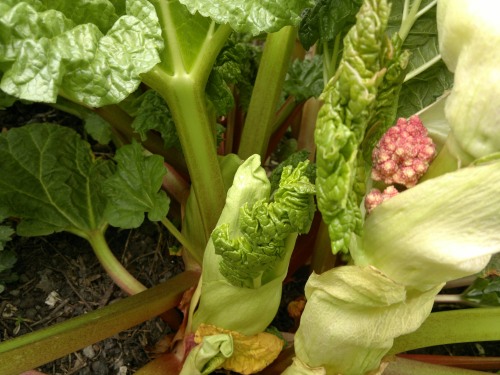
rhubarb-flowers-dissectedI’ve got several rhubarb plants. Two of them have already produced 4 flower stalks each. This means the plant is stressed. Whether it is because of the cold weather and then the dry weather I am not sure, but I do know the plants aren’t happy.

The flower stalks are strange looking chunky upright shoots that are quite thick. You can pull them off or cut them out if you find that easier.

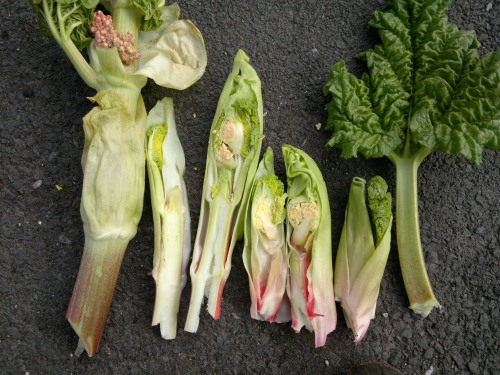
I’ve removed four and cut a couple in half to show the pale pink cauliflower like flower inside. The large flower on the right was starting to unfurl.

It looks like it might be an interesting flower. I might leave the next one I find to flower properly so I can get photos of this too!
The idea of removing them as soon as you see them is that the plant puts a lot of energy into making the flowering shoots and so it takes away essential energy from the rest of the plant’s crop.
More flower heads means less edible rhubarb.
I think it’s time for a crumble!


Allotment wordsearch

Wednesday, May 1st, 2013
Y
B
R
A
B
U
H
R
S
N
R
W
C
L
V
T
H
G
M
M
R
A
A
L
C
I
C
N
B
E
E
T
B
O
A
U
R
I
P
R
B
E
B
T
R
R
O
D
L
U
P
R
A
M
R
F
P
E
O
N
S
I
G
E
O
B
S
E
T
A
A
N
E
N
T
L
Z
W
X
M
R
G
C
T
A
P
P
L
E
R
G
R
E
E
N
H
O
U
S
E

Words to find
ALLOTMENT
GREENHOUSE
CROPS
MANURE
PLOT
WATERING
WEEDING
CABBAGE
CARROT
FRUIT
RASPBERRY
APPLE
RHUBARB

Security on the allotment

Tuesday, April 30th, 2013

If you have a shed then you need to make a decision about how secure you make it. Some people leave them unlocked and hide all their valuable tools under piles of rubbish or in secret doors.
Engraving your postcode and house number on tools might mean you stand more chance of recovering them if they do get stolen. This does rely rather on people reporting thefts though. It is always worth ringing the police and getting a crime reference number even if you don’t want to claim on insurance. It is important for crimes to be logged and then if they recover garden tools they have a list of what you’ve lost.

If you keep large items like rotavators on site then a concreted in hoop to chain it to can be the solution. Whilst they could cut the chain it’ll take longer and be more effort.

Some plotters use trail cameras to record images. There are lots of wildlife cameras suitable for hiding away on an allotment.

Your local police will also have a crime prevention officer who could visit and give advice on improving site security.
Most sites insurance will insist that the gates are kept locked all the time.
This is a good idea for security and essential if people aren’t prepared to challenge people who wonder in off the street.
Recently I watched someone walking round the site past a plot holder who just ignored them. I went and spoke to the person and gave them a tour of the site. It is better to check who people are and what they’re after rather than let people mooch about and then have tools disappear.

Hardening off plants

Friday, April 26th, 2013

If you take tender plants from the greenhouse and plant them out then you risk damaging the plants, stunting their growth or even killing them.

The process of preparing plants for being planted outside is called hardening off.

You must gradually introduce plants to the outdoors.
A greenhouse or cold frame provides shelter from cold temperature extremes, wind, rain, animals and pests, frost and snow.
The process of hardening off needs to be done slowly enough to not shock the plant when it is planted out finally.

Some steps can be:
putting plants outside during daylight and then moving them in at night, gradually extending the time outside. Use of cold frames without lids can allow exposure to some elements. Use of fleece when you plant things out, or windbreaks, can soften the impact of planting out.

Plants that are frost sensitive need to stay under cover until after frost risk has passed. Having sheltered corners of your garden can be useful for larger plants. Wrap them in fleece if it’s going to be cold.

If you need to plant out in a hurry then you must be prepared for plants to have a stop in their growth if they are not hardened off properly. It comes as a real shock to plants when they are exposed to the wind, rain and cold of outdoors.

Homemade cold frame

Wednesday, April 24th, 2013

I found some polycarbonate by a skip, asked and bought it home!
Some has been turned into cloches for my allotment, and some into this cold frame.

Scaffold board sides and hinged top.

Homemade coldframe

Not quite full yet but will be using it to harden off as well as start more seeds in. It gives shelter from the worst of the weather and is really useful!

Finding growing space

Wednesday, April 24th, 2013

Thee’s a project on in Trafford to find growing space
http://www.kindling.org.uk/node/1128

When: 1st or 15th May, 5.30 – 8pm. Supper provided.

Where: St John’s Centre, St John’s Road, Old Trafford, M16 7GX

The Centre is on St John’s Road, behind the big red church (St John’s) on Ayres Road in Old Trafford.

Agenda for the evening:

5.30 Welcome – project objectives
5.40 What are we looking for?
5.50 How to record the data
6pm Supper! and Q&A
6.15 Walking the streets – data collection (in pairs)
7.15 Return to St John’s Centre – upload data – feedback
7.45 Presentation of populated map – Q&A
8pm Finish

recycled bench

Wednesday, April 17th, 2013

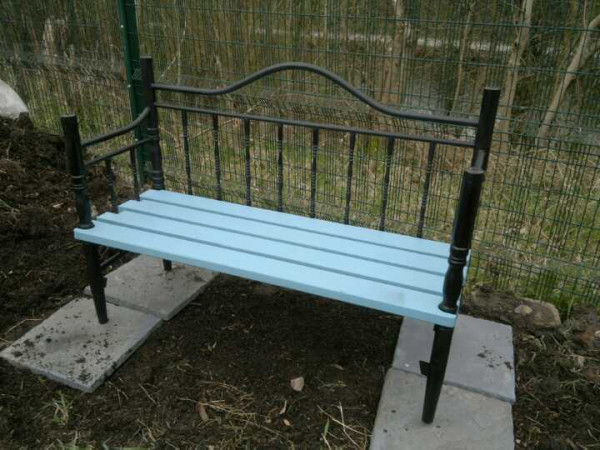
Nic (my other half) and my friend John off the allotment were stood about chatting yesterday and eventually one of us said something about needing a sit down. I mooched over to the bedstead and short scaffolding boards I have on my plot and mused aloud if they could be used to make a seat.
The answer? Yes they can.
Beautiful isn’t it! Beautiful bench

Why sow in straight lines?

Monday, April 8th, 2013

It’s easier to work out which seeds are the ones you planted and which are weed seeds if you’ve sown in a straight line.
For ultra straight lines use a piece of bamboo cane pressed into the soil.
Label everything you sow. You will not remember otherwise!

The great pallet collar allotment plot

Thursday, March 28th, 2013

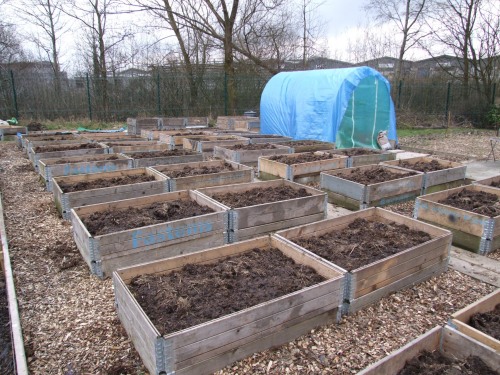
The pallet collar plotPallet collars are pallet sized collars that are hinged box sides. They’re used for storing stuff on pallets.
I’d seen some on a plot, but it was only when I discovered one labelled as a pallet collar on the internet that I realised where I might find some. My local pallet yard sold me some at £6 each which was cheaper than me building a raised bed from wood, and definitely easier than the effort of me making raised beds. I used about 8 on my plot. Someone new joined our site and whilst showing him round my plot, he realised he had them at work in the engineering section. So he went and asked nicely and got given a load: A serious load! His source has dried up now unfortunately but not before he’d laid out his allotment how he wanted.

I’m a bit jealous as he got his for free – although eh did have to load them into his car and fetch them to site himself, which took several trips. He’s now got an excellent looking plot.
He’s filled his boxes with manure and has mixed in some coffee grounds he also gets from the café at work. His seedlings are growing in his plastic greenhouse and will be ready to be planted out soon enough.