Garden And Gardener

Everything for the Gardener and their Garden

Archive for the 'allotment' Category

Allotment news round up

Monday, May 14th, 2012

Witney Allotment Association has now signed an agreement to lease three sites – in Lakeside, Hailey Road and Newland – from Witney Town Council.

The association will manage the rents, plot allocation, maintenance and waiting lists for the 175 plots.

AN allotment holder has been kicked off his plot after he complained that he was being plagued by bees.

James Flemming, 61, had been gardening at Old Basford Allotments for several months when bees from hives on a neighbouring plot started swarming and stinging him regularly.

AS MANY as six sheds each week are being torched at Birmingham allotments

But Ealing and District Bee Keepers’ Association carried out research in 1998 and recommended no more than two hives on an allotment plot. It said hives should be placed in the centre of a plot so they were not close to the boundaries with a neighbour.

Allotment News round up

Friday, May 4th, 2012

The south west of England is busy with allotment news

Gardeners rush to sign up for new allotments in Plymouth – exciting idea – The community scheme on the National Trust’s Saltram Estate, near Plymouth, was first mooted last year as part of a national scheme to create 1,000 new allotments.
Will create 40-50 new allotments and is already oversubscribed.

Seaton Allotmenters stand firm – threat of closure

And elsewhere:Shoppers at Crowle market can now get seeds, plants, fresh vegetables and handmade produce at the new North Axholme Allotment Society stall.

Slug Gone Slug Pellets

Friday, May 4th, 2012

Slug Gone wool pellet slug repellent Slug Gone – Organic Natural Pure Wool Pelletts Slug Repellant (20 Litre Bag)Slug Gone Slug Pellets
This is a really exciting alternative to normal slug pellets.

What are slug gone pellets made from?
They are made from the fleece of sheep.

How does this work?
Wool fibres have very fine scales with small barbs on the tip called cuticle cells. These cause wool fibres to felt and matt together. Wool fibres are very hygroscopic and this plus the sand and grit already in the compound and the potassium salts from the sweat glands of the sheep absorb some of the slime from the slug’s foot to cause irritation, resulting in the slug finding easier feeding methods.

‘Slug Gone’ wool pellets are composed of 100% natural materials including phosphorous, nitrogen and potassium. As soon as water is added the fibres swell to form a barrier or insulation blanket. When slugs climb onto the fibres it irritates the foot and causes it to seek easier feeding elsewhere.

‘Slug Gone’ wool pellets are ideal for organic gardening and can be used in pots, flower beds, borders, allotments, herb gardens, nurseries, garden centres, green houses and vegetable plots.

How do you use these slug gone pellets?
To Use: Clean the area around the plant and place the pellets to fill the surface of the pot, or in a 6″ circle around the plant. Make sure all the pellets are touching. Water well and soon the pellets will swell and bind together to form both a prtotective and insulating blanket.

Contains: Nitrogen 3.6% Phosphorus 0.4% Potassiu8m 3.1%
These elements are slow released as the pellets biodegrade, taking up to 12 months

Is it safe?
This product is entirely safe for children, pets and wildlife. Not only do the pellets keep Slugs and Snails at bay, the pellets are also a good mix and balance for growing plants, fruit and vegetables.

And there’s more…
The pellets hold twice their own weight in water so they act as an excellent mulch, a weed suppressant, a soil conditioner and slow release fertiliser! Slug Gone is 100% natural, ideal for organic gardening and is safe for children, animals and garden wildlife.

Costs?
Slug Gone – Organic Natural Pure Wool Pelletts Slug Repellant (20 Litre Bag) – Price: £21.99
At Amazon – Slug Gone – Organic Natural Pure Wool Pelletts Slug Repellant (20 Litre Bag)

New Allotment – where to start

Friday, May 4th, 2012

When you get your allotment you will be so excited! You’ll also have a huge jolt of fear about what you’ve taken on.
Hopefully you’re taking on a perfectly maintained plot, with a history showing you what’s planted where, what crop rotation has been going on, when the soil was last limed, and what varieties the fruit trees and bushes are.

Of course reality is never like that. You’ll have a plot that’s waist height in weeds, with everything so overgrown you can’t tell what’s what. You’ll have such a variety of weeds that your heart starts to pound with fear at the horror stories you’ve heard about the invasive weeds now lurking on your little bit of heaven.

If you’ve got a blank canvas than that can be as frightening as a really badly overgrown plot – where do you start?

Whatever your plot is like you should not rush to pick up a spade. The first temptation is to rush in and not plan anything out.

You should start an allotment notebook. Measure the site and write it down in your book. Mark on which way is north, and where the paths are. On a hugely overgrown plot it can be hard to tell if you’ve got anything in there but have a good look at every section and try to work out what’s growing there.

An important note to make here – when you start digging over your plot and you find strange roots then put them to one side and explore a bit more. If you find more roots the same then you’ve uncovered a bed of something. Ask someone with plenty of experience what the roots look like. You might be digging up a perfectly good bed of something tasty!

Depending on the time of year there might be evidence of plants coming up. If you suspect there are plants that you want to keep then ask neighbouring plot holders if they can remember what was planted on your plot. They might not remember but it is worth enquiring.

If you have a shed or greenhouse on your plot then you are very lucky! Measure how big they are and make a note of what’s in there. Is the greenhouse complete with staging, does it need glass replacing? If you measure the size of glass you need and keep the measurements with you then next time you see a glass cutting shop you can pop in and find out how much new glass costs and even get it cut then rather than having to come back with the measurements.

Once you’ve make a note of everything you can possibly make a note of then start taking some photos. With a digital camera it’s easy to take lots of photos. Take some crouched down to give you a different view of the plot. Take from the corners diagonally too and stand at either side and take photos along the boundaries.

It’s probably then time for a cup of tea and a sit down to have a think about where to start!

Borage

Thursday, May 3rd, 2012

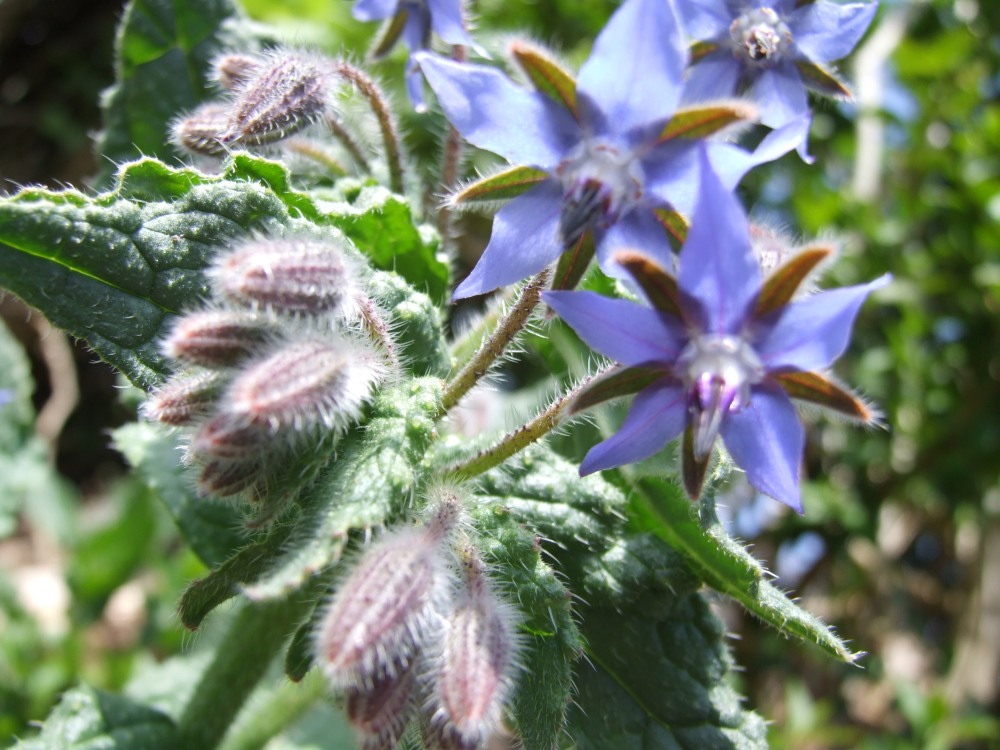
Borage flowerThere’s this plant on the allotment in the hedge that’s finally flowered. The flowers are blue. I think it’s borage.

Borage is a hardy annual.

You can use the pretty blue flowers in a salad or you can prserve them for topping cakes with. They are very pretty little blue stars.
Tea made from borage is supposed to reduce fever.

Also available in a white version from Crocus

borage (borage - organic)

borage (borage – organic) £1.99
Position: full sun or light shade Soil: fertile and moist Rate of growth: fast Hardiness: hardy annual (it will die within one year) A wonderfully useful as well as decorative plant. The young leaves and vivid blue flowers of this annual herb have a fresh cucumber-like flavour, so are often used in salads, soups, chilled drinks or simply as a garnish. The flowers attract bees and other beneficial insects, while the foliage has been known to reduce attacks of hornworm when planted between tomato plants. At the end of the year, add the plants to the compost heap as they will promote many beneficial minerals. Borage is an annual plant, but it will self-seed readily in good conditions. If you don’t want more plants, dead-head the flowers as soon as they fade. Garden care: Form shallow drills at 30cm intervals in a well prepared bed, and sow thinly, just covering the seed before watering well. The seeds have a higher germination rate when temperatures are between 15 – 25C, so early sowings can be covered with a cloche. When big enough to handle, thin the seedlings to 25cm. Sow: March – May Flowering: June – September Approximate quantity: 75 seeds.

Read the rest of this entry »

Allotment jobs

Wednesday, May 2nd, 2012

There’s a job on an allotment here
Gardener/Volunteer Coordinator at St Anns allotments in Nottingham.

St Anns Allotments have a vacancy for a part time horticulturalist. Responsibilities include the setting out and management of our heritage display garden, recruitment and management of volunteers, propagation and selling plants for sale. This is a one year contract, 12 hours a week, including some weekends . Hours may be seasonally adjusted, and the position may be extended subject to income generation. Salary £10.50 per hour.
The funding for the post has been given by The Finnis Scott Foundation.


Garden/Land Manager
Type of job: full time
About the Job:
Required in south Oxfordshire, on 22 acre estate comprising semi-formal gardens, small orchard, woodland and fields, with Grade II Listed Barns (in need of development).

Position requires:

(i) organic gardening, knowledge of trees & shrubs, care of land

(ii) basic financial/organisational skills, eg preparing budgets and spread-sheets

(iii) creativity/imagination in order to realise potential of property & develop projects with owner, beneficial to the local community.

Accommodation available.

Salary negotiable.

Contact: anthea@antrus.co.uk

more jobs listed here

Do you know any allotment jokes?

Wednesday, May 2nd, 2012

Somebody keeps putting soil on my allotment each night. It’s a complete mystery. The plot thickens…..

My experiment with grass clippings

Wednesday, May 2nd, 2012

With the huge pile of grass clippings we got I decided to have an experiment.
I’ve got one end of a bed that tends to be a bit damp so I thought I’d experiment on this as I’m not sure what to grow in it yet.


This first video shows that I’ve put a layer of grass clippings all over the section of the bed at the end.


I’ve put out the seed potatoes in three rows along the grass cuttings and started to cover it up with top soil.


The potatoes are all covered up with top soil now.

What I might do with one end of the bed is mulch it up with straw, and mulch the other end of the potato bed with grass clippings. It’ll be a great chance to see if there’s any difference between the two.

Rabbit poo

Tuesday, May 1st, 2012

Question – Can you use rabbit poo on your allotment?
Answer – You can but you’re best composting it first.

If someone you know keeps rabbits and is happy to give you the waste then add it to your compost bin.

Grass clippings – free!

Tuesday, May 1st, 2012

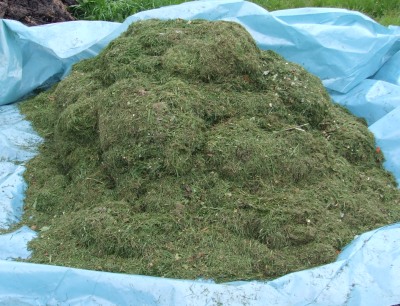
Big pile of grass clippingsWe have some grass areas on our street that get mowed by the council. Today I spoke to the man mowing the grass and asked if it was possible we could have the clippings on the allotment. He was very pleased to offload them with us as he has to travel some distance to empty the mower so it saved him time!
We got a big pile of grass clippings out of it too.
You can use grass clippings as a mulch on potatoes and it’s supposed to stop potato scab from forming. It’s also good as a mulch around onions and other plants. It can be used around shrubs too.

You’re not supposed to add it in really thick layers though else it heats up. Add a couple of inches at a time and it’s fine though apparently.
Free mulch is great and I know several people are going to be using this either as a mulch or on their compost heap.

I’m really pleased I caught the bloke this week as he’d been a fortnight ago but whilst I was out!
Just shows it pays to ask!

Would you like to know why you don’t pile deep grass clippings round plants?


They get hot.
This pile was at 30’C inside after just a few hours on the allotment. They were dropped off about half 10 this morning and it was about 7pm when we were outside taking the temperature.

The next day it’s at 41.5’C! Impressive! it’s changing colour inside going yellowy.